Search

Keep Asking Questions

Unheard Women: The Unspoken Suffering of Nonwhite Women

During my year in Humanities Core, I have analyzed the Ancient Roman Empire and select historical moments all the way to Modern Iran. My writings have been focused on the “othering” of minorities and the inequalities of women, but in my reexamination of what I’d learned, I realized that I never combined them together. I looked at women through the lens of a white woman, never bothering to widen my scope. I am now taking the time to talk about women mentioned throughout Spring Quarter.

Their experiences are not to be ignored.

Here is the cover page of “The Trial of Captain James Dunn, for an assault, with intent to seduce Sylvia Patterson, a Black woman (1806).”

In the 1700s, nonwhite women were depicted as sexually promiscuous. There was an ethnic appeal attached to them, and since they were already viewed as “lower” than white women, they were seen as being less likely to say “no” to a sexual advance. Back then, rape was defined as “carnal knowledge by force and against her will” (since men weren’t acknowledged as being able to be raped). White women were seen as pure, and even they had trouble convicting men, especially white men, of raping them, which gave nonwhite woman a virtually impossible task. As an example, Sylvia Patterson, a black woman, had her case prejudiced against since the very beginning. The cover of her trial (shown above) depicted her attacker, Captain James Dunn, pulling on her dress and offering her a watch. Even though the watch was actually offered to Patterson’s husband to try and keep the case from going to trial, it is depicted as being offered to Sylvia as a form of prostitution. Many of her neighbors were called to testify that she was a “whore,” which is unlikely to have happened if she was white.

Here is an image of women wearing the chador. 

The chador is a traditional head covering that is often worn by Muslim women. In Iran, it has been required on and off for many generations, but it is used as a means of protecting a woman’s chastity. It is too difficult for men to practice self-restraint, so it is up to the women to cover their skin and hair and refrain from being too provocative. Much like in many other societies, men are not responsible for their actions regarding women. Women must take all the precautions against sexual abuse whether they are from the United States, Iran, or even Vietnam.

There is not a number that can be placed on them, but the amount of Vietnamese women who were raped as a systematic tactic of war is appalling. In an interview with Nick Turse, a former soldier in Vietnam, he states that “A lot of times I found myself, I felt I didn’t have the language to describe exactly what I found in the cases, because rape or even gang rape didn’t seem to convey the level of sexual sadism. These are extremely violent gang rapes, or raping women with inanimate objects like bottles or even rifles.” American soldiers were trained to dehumanize the Vietnamese so that killing, or raping them, would be easier, but it just made them become the real monsters.

These are just some of the women who go unrecognized for their sufferings throughout history. Writing does not change what has happened to them, but it does help spread their stories and the awareness that white women are far from being the only victims.

It may be late, but it’s time for a change.


Header: https://www.thoughtco.com/asian-wars-4133317

Out of the Ashes and Into the Fire

“There was a silly damn bird called a phoenix back before Christ, every few hundred years he built a pyre and burnt himself up….But every time he burnt himself up he sprang out of the ashes, he got himself born all over again. And it looks like we’re doing the same thing, over and over, but we’ve got one damn thing the phoenix never had. We know the damn silly thing we just did. We know all the damn silly things we’ve done for a thousand years and as long as we know that and always have it around where we can see it, someday we’ll stop making the goddamn funeral pyres and jumping in the middle of them” (Bradbury 156).

Books are more than just entertainment or make-believe stories; they often hold wisdom that many of us are too afraid to say out loud.

Fahrenheit 451 is a novel that was written by Ray Bradbury in 1953.  In this dystopian universe, all books containing any controversial materials are burned, in order to keep everyone “happy”. In fact, knowledge is a threat to the Government because it encourages questions and would lead to people seeing the faults in their society. This is exactly what happens with Montag, a former fireman, who begins to read and escapes from the confines of his government through knowledge. This particular passage takes place in Part three, entitled Burning Bright. Montag’s city has just been blown up by bombs, and Granger, the leader of a group of intellectual hobos, speaks to him about the persisting faults of humankind.

The phoenix is a bird made completely out of fire. Though they were believed to live for thousands of years, depending on the culture, it was agreed that as they neared the end of their life, they would create a pyre nest and set itself on fire, only to be reborn in the ashes. Phoenixes are often used as symbols of loyalty, honesty, and creation, but here Bradbury is using the phoenix as a metaphor for the mistakes of people.

Unlike the Phoenix, claims Granger, humans know what will happen when they repeat history. Humans have no excuse. We have no excuse, yet, we keep making those mistakes. We keep waging wars. We keep destroying the environment. We keep implementing racecraft and racism. Every time it seems like we are taking steps forward, we take even more back.

The phoenix of humankind is not creation, it is ignorance. It is ignorance about the most basic aspects of life that we continue to ignore. Ray Bradbury wrote this novel in the ’50s, but it has so much relevance to what is happening today, especially in the United States.

Only recently, the House of Representatives voted to pass the American Health Care Act, more popularly known as “Trumpcare.” With this new form of health care, funding for essential programs is being cut and rape is being seen as a “pre-existing condition,” which means that people who have been raped will either not be covered, or have to pay ridiculously high amounts to get coverage. Along with rape, depression, AIDS, and transsexualism are on this list.

These are the kind of decisions that “made America great” back in the 1800s when slavery was still allowed and only white, rich, Christian men had any power. The only thing that has changed, so it seems, is that slavery is no longer legal. The 99% stand voiceless on the sidelines as the 1% emerges from the ashes.

We have books, so what is our excuse for jumping into the pyre?


Works Cited:

Bradbury, Ray. Fahrenheit 451. New York: Simon and Schuster, 1967. Print.

Header: https://thecringeblog.com/category/the-arts/written-word/


Successful Assault

Woody Allen, Sean Penn, Bill Cosby, Casey Affleck, Donald Trump; What do these incredibly successful, famous men have in common besides their wealth and popularity to the public?

They have all been accused of sexual assault and got away without any or little social backlash or repercussions. Even if they did receive anger from their actions, it did not stop them from climbing the social ladder and reaping its rewards.

Even without the fame and fortune, violators of sexual assault are rarely punished for their crimes. In fact, in the recent and well-known Brock Turner case, many newspapers referred to him as the “Stanford Swimmer” rather than the “Stanford rapist.”

Sexual assault, including rape, is the only criminal case where the prosecution, meaning the victim or the one filing the lawsuit, has to come up with the burden of proof. In most lawsuits, the defense needs to come up with enough evidence to prove their party innocent, but when it comes to sexual assault, the prosecution must prove that the accused actually did the crime.

This is just another one of the ways that society’s perception of sexual assault is distorted. Even the criminal justice system makes it harder for survivors to get justice for what happened to them.

In a multitude of ways, rape is seen as just a joke.

go-ahead-call-the-cops-they-cant-unrape-you-funny-sloth-rape-memes-graphics

This is one of the many “memes” I found regarding rape. Though it may be seen as troublesome, I chose to include it to support my claim. 

(Source: http://picsmine.com/40-naughty-sloth-rape-meme/)

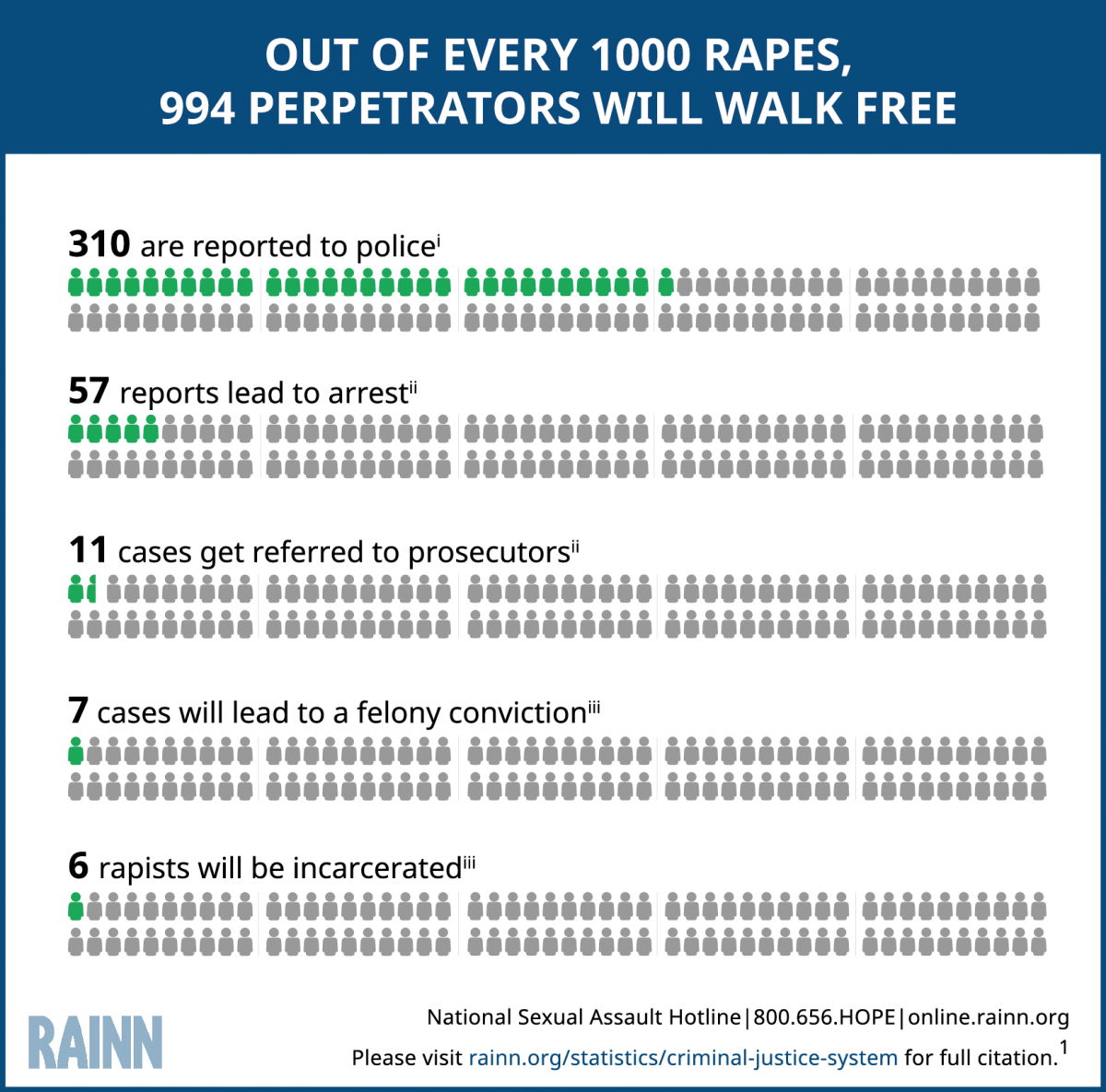
Sexual violence is not a joke. If it seems like a funny matter, try talking to the 1 out of 6 American women who will face attempted or completed rape in their lifetime. As shocking as that statistic may be, it does not include the countless men, women, and transpeople who suffer this violence around the globe. In fact, most cases are never reported to the police.

Graphic demonstrating that out of 1000 rapes, 994 perpetrators will walk free. Out of every 1,000 rapes, 310 are reported to the police, 57 reports lead to arrest, 13 cases get referred to prosecutors, 7 cases will lead to a felony conviction, 6 rapists will be incarcerated.

This is a statistic sheet on sexual violence found on the RAINN website regarding criminal justice.

(Source: https://www.rainn.org/statistics/criminal-justice-system)

When a case is won and the violator is persecuted, many times that person will spend a limited time in jail, often less than one year. Some spend as little as one day.  While it may be difficult to find a proper punishment for this type of abuse, I find the short prison sentences insulting, considering the physical and psychological damage done to the survivor and frequent harassment endured during their trial.

When society views most survivors as “sluts” or girls that were “asking for it,” they have already taken the side of the rapist and erased the survivor’s experience. They have appropriated the idea that men can’t be raped and that girls should just “give it up.” They have turned the survivor from a person into a statistic. They have supported the idea that rich, privileged men can do whatever they want to women and still go on to win an oscar or even the presidency.

Enough is enough.

Here is a video of segments of former Vice President Joe Biden’s speech on the treatment of Rape survivors. This speech was given on April 5, 2016 at the University of Pittsburgh, 

(Source: https://www.youtube.com/watch?v=ZM5QxYIj2qo)

I couldn’t have said it better than Joe Biden does in his speech. We constantly say “boys will be boys” and excuse the actions of rapists from the time they are only in kidergarden tugging on a girl’s skirt until they are in their sixties, still treating people like pieces of meat.

What needs to become clear is that rapists cause rape. It is not the length of a skirt or ruthless pheromones, but rather the actions of the rapists. A rapist can be a man or a woman, and so can the survivor. By allowing sexual violence to be viewed in its current misconception, stereotypes are being reinforced and people are still being rewarded for what they never should have done.

Assault should ruin success, not support it.


Header: http://www.soc.ucsb.edu/sexinfo/article/myths-and-facts-about-sexual-assault-and-harassment

The Upas Tree of the United States

“An eye for an eye only ends up making the whole world blind.” – Mahatma Gandhi

At a time when people are boycotting Uber and any other company supporting Donald Trump, there is a sense of panic and overarching doom in the land of the free. Issues that the mass population thought were nonexistent have been revealed to be as super-sized as our fast food menus.

Racism runs rampant in the country where “free” now means gender inequality, Muslim bans, homophobia, cutting public school funding, disbelief in environmental problems, and never-ending walls. All of this stems from the roots of what I will call the United State’s personal Upas tree.

The upas tree  is a tree that secretes a deadly poison and has been used by many, notably Mahatma Gandhi, as an analogy for problems within institutions.

Here is an image of the poisonous upas tree being portrayed as the effects of the smallpox vaccinations. This was produced by anti-vaccinationists in the early 1900s.

(Source: http://www.historyofvaccines.org/content/upas-tree)

Gandhi uses the analogy of the upas tree to show his opposition to the medical industry and their allowance of human indulgence and misconduct, but this idea can encompass the United States as a whole. As a nation, we are so fixated on convenience and personal satisfaction that we ignore the deep-seated issues of our government, society, environment, and more.

“For the sake of a mistaken care of the human body, they kill annually thousands of animals… No religion sanctions this. All say that it is not necessary to take so many lives for the sake of our bodies” (Gandhi 60).

Our country is built on the graveyard of Native Americans. We have shipped people over the sea and branded them as inanimate objects. We use fossil fuels as a means of easy transportation. Factory farms in the United States utilize enough grain to stop world hunger in order to feed their inhumanely treated animals. Our country has become a product, even a factory, rather than a democratic nation.

We are supposed to learn from the mistakes of our past, but still our nation continues to exploit the resources of our world for the privilege of a few.

If we look at India and their constant struggle to be free from the British Empire, it can be seen that at some point, what they lived with forever could no longer be tolerated, or even endured. No matter what their alternative was, they had suffered enough. They ultimately got their freedom, but can the United States? Can the United States free ourselves from an empire that is so engrained into how we live each and every day?

The upas tree of the United States is ignorance.

I am disappointed to live in a country where social media and selfies have become more important than solving global warming. A world where people would rather be ignorant of all problems instead of working to fix them. The only good thing about Donald Trump is that he’s started to open the eyes of people who never acknowledged the problems that he is now making it harder to solve.

Is this our point to fight back? Can we live with the country we’re in? Or will we endure it until it is too late to reverse the damage?

Gandhi, Mahatma. ‘Hind Swaraj’ and Other Writings. Cambridge: Cambridge University           Press, 2009. Print.

Header: http://www.loc.gov/pictures/item/2012647280/

Depictions of Caliban: Making a Monster out of a Man

From the earliest times of colonization, the “new world” has been seen as a land of fantasy. Those who inhabited these lands were depicted not only as whimsical creatures, but even as the exact opposite too. These indigenous people did not choose how their image would be carved into history. Instead, their captors, having conquered their land, decided to justify their mass slaughter and looting by creating the myth of native desolation.

Native desolation is the false belief that indigenous people were innocent and childlike, yet cannibalistic and nefarious, were culture-less, pagans, and viewed the incoming Spanish conquistadors as Gods (Restall). Some of these terms are contradictory, but they were still how the natives were viewed.

This viewpoint was displayed in various pieces of art and literature, but most notably was William Shakespeare’s character, Caliban, in his play, The Tempest.

Caliban is the sole inhabitant of a lonely island when Prospero and his young daughter arrive. Throughout the play, Caliban is insulted, downgraded, and made a mockery of. His character is defined by those around him, namely his tyrant and master, Prospero. He is described as being a “fish,” “monster,” “hagseed,” and even “slave” (Shakespeare).

Shakespeare’s monstrous imagery surrounding Caliban has been translated into various pieces of visual and performing arts.

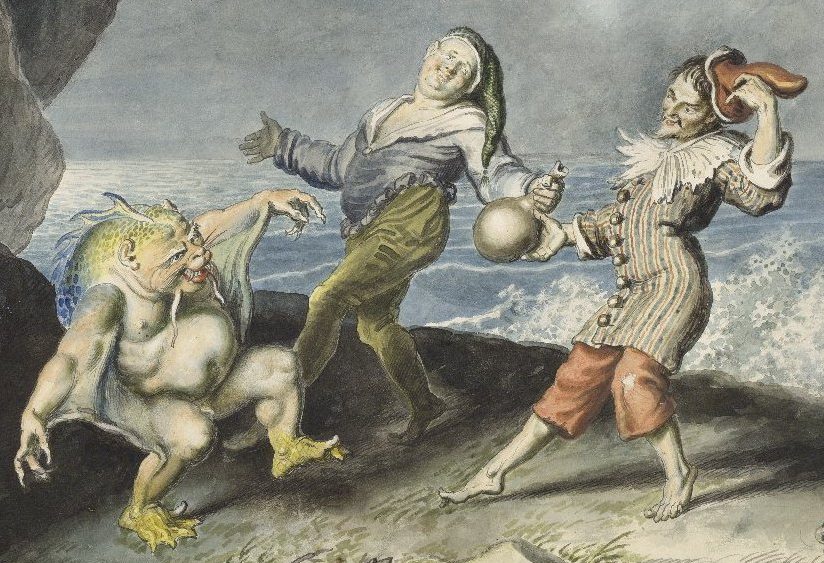
This is a painting of Caliban (left), Stephano (Center), and Trinculo (right), created by Johann Heinrich Ramberg.

(Source: https://en.wikipedia.org/wiki/Stephano_(The_Tempest) )

In this painting, Caliban barely resembles a human. In fact, he looks like something out of a nightmare. This follows Shakespeare’s description of Caliban as having “claws” and being a creature that is deceitful, longing to rape an innocent girl, and willingly submitting to slavery. In fact, Caliban’s own words in Act 2, scene 2 of the play reflect the myth of native desolation. After searching for freedom for years, Caliban meets a drunken cook and declares “I prithee, be my god” (Shakespeare 46) after tasting his liquor.

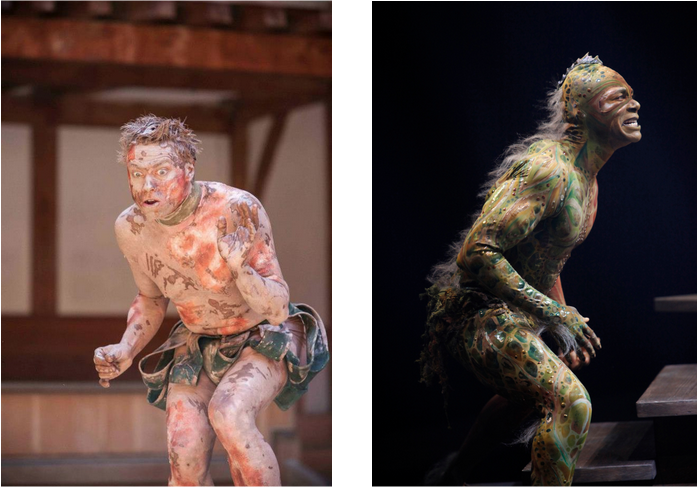
The left picture is of  Caliban in the Globe Theatre’s 2013 Production. The right is of Caliban in the 2010 Stratford Shakespeare Festival

(Source: http://aplanguagemrphillips.weebly.com/the-tempest.html )

Even in more modern productions of this esteemed play, Caliban is portrayed as less than human. He is shown as animalistic and barbaric, as a creature that deserves no pity. But has anyone stopped to think about Caliban’s perspective? It is so easy to interpret the play from Prospero’s point of view, but there are two sides to this well-known story. Julie Taymor, a renowned director, made the decision to see Caliban as a human and to tell his side.

This is a picture of Caliban from Julie Taymor’s 2010 film production of The Tempest.

(Source: http://collider.com/julie-taymor-interview-the-tempest/ )

In her 2010 film adaptation of The Tempest, Taymor did not costume Caliban in a way that showed him as a monster. She brought out the humanity in him by leaving him human. Portrayed by Djimon Hounsou, Taymor’s Caliban is engaging, strong, empathetic, and able to be cared about. While watching him, we feel his anguish. We see his struggles, his pain, and most importantly, his perspective. We see how Prospero’s words have confined him more than any cage ever could.

The image of a white woman with an enslaved African does not go unnoticed.

Taymor carefully constructed her film to show the flaws, not in Caliban, but in Prospero. Whether Prospero is portrayed as a woman or a man does not matter, for the crimes committed are the same. Prospero wrongfully conquered a nation that was not his, and enslaved all the inhabitants there. It is in these depictions that we can see the wrongs of the past, not only fictional, but in our country’s true history as well.

In order to see the men inside of monsters, we need to stop labeling them as monsters before we know anything about them. It is often those who seem the most “perfectly” human that turn out to be the biggest monsters of them all.


Header: http://eng433.pbworks.com/w/page/44880523/_The%20Tempest

Restall, Matthew. “The Indians Are Coming to an End.” Seven Myths of the Spanish Conquest. New York: Oxford UP, 2003. 100-30. Print.

Shakespeare, William. The Tempest. New York: Signet Classics, 1998. Print.

Intersectional Feminism: Why We Must March for ALL Women

“I am not free while any woman is unfree, even when her shackles are very different from my own.” – Audre Lorde

We do not live in an equal world. In fact, those of us that live in the United States, a country that is thought to be progressive and “perfect,” do not even live in a country that is equal. One of the most commonly used examples is the pay-gap between white men and women, but as with most political arguments, people of other demographics are ignored.

chartoftheday_3958_gender_pay_gap_by_ethnicity_n

In this chart, the gender pay gap is shown, including the differences in pay by ethnicity.

(Source: https://www.statista.com/chart/3958/gender-pay-gap-by-ethnicity/ )

And pay isn’t the only example where one group is left out for the benefit of others. Many activist groups will ignore the issues of another in order to further their own cause. In the 1920s, when women were fighting for their right to vote, the suffragettes banned African American women and people of color to join in their fight, because they wanted to ensure the vote for themselves. 

African American and Native American women did not actually get the vote until 1965, when states became unable to refuse people the right to vote based on race. We never hear about this in History class, however, because the United States is trying to protect itself in a fabricated bubble of equality.

This is why we need intersectional feminism. There are no problems in this world that can be solved by one group alone. We need to work together if we want results.

This is a video by Laci Green and Franchesca Ramsey in which they explain what intersectional feminism is, and why we need it.

After the recent 2016 election, the United States has been in a state of division and discontent. Even with the amount of diversity and “acceptance” in our country, a seemingly racist, misogynistic, and overall rude man has taken the place as the leader of our nation. This causes concern for not only women, but for African Americans, Native Americans, Muslims, anyone LGBTQA+, disabled people, and basically anyone who isn’t a white, christian, middle-to-upperclass male.

So what did we do? We protested. We started the incredibly widespread “Women’s March on Washington,” with over 750,000 people in our capitol, and sister-marches in every state and in tons of countries around the world. It was one of the biggest protests to date, but even this wonderful, inspiring march had its problems. It was a march against oppression, yet it still ignored many of those who were being oppressed.

Women's March

(Source: http://fortune.com/2017/01/21/womens-march-protest-trump/ )

It was a women’s march, but the ideology behind all of the chants and beliefs presented were strictly liberal. There is nothing wrong with that, but it does ignore the fact that not all women have the same belief systems. 

I was fortunate enough to be able to attend the Women’s march in Orange County, and I did think that it was a very powerful and important step for the United States. That being said, most signs were geared towards people with vaginas and said things such as “Pussy Grabs Back” or “Viva la Vulva,” which are clever and poke fun at things our President-elect has said or done. This focus, however, ignores transwomen. It makes the assumption that all women have vaginas, when in reality, gender is something fluid and subjective. 

We simply cannot have a women’s march if we don’t include ALL women. And men, for that matter, because as humans, we need to fight for and take care of one another.

Intersectionality means that everyone, regardless of their race, gender, religion, or sexual orientation, will be included and need to collaborate to fix overarching problems. You can’t fix sexual violence or rape without including African American women and bisexual women, who are far more likely to experience these things than any other group. Every single issue mingles with the rest.

There is nothing wrong with feminism, we just need to make sure that it includes more than just white, middle-class women who won’t fight for anything besides reproductive rights. 

I am a white, pansexual, lower-to-middle class woman who is hoping that our nation will come together instead of apart due to the changes occurring. I am hoping that we will stand together and embrace our differences, instead of shun them.

Now think; what would you stand for?

Header: http://everydayfeminism.com/wp-content/uploads/2015/01/Screen-shot-2015-01-07-at-12.42.20-PM.png

Us V.S. Them: The Obsession with Categorization and Separation of “Others”

“Humans can’t help being racist. Our brains are programmed that way. It’s normal.”

Whether it is based on race, sexuality, or gender, these are the types of excuses used to rationalize and excuse prejudice. While it is true that our brains are predisposed to finding patterns and creating fear for differences, that doesn’t mean that we can’t rewire our thoughts and try to make a change. Our families can influence us as much or even more than society, but it is ultimately up to us to make our decisions.

In fact, this type of outcasting is so prevalent that there has been so many novels centered around this theme of “Us V.S. Them.”

One of the most notable stories of this kind was written between 29 and 19 B.C.  The plot line of The Aeneid, an epic poem by Virgil, is a product of the Trojan war. This war was fought between the Greeks and the Trojans, over a woman (Virgil). Neither side tried to come to an agreement or talk out a solution, they just determined that the other group was the enemy, and ultimately wrong, thus resulting in bloodshed.

Even in the Annuals, written by Tacitus, the entirety of the Roman Senate wanted to keep foreigners out of government. They were hesitant to even allow these people to be citizens, and they saw giving these strangers more power as dangerous. Yet, Rome gave captured people the same rights, due to the decision of Emperor Claudius. He, never being influenced by his narrow-minded Senate, saw the value in differences (The Complete Works of Tacitus)

In Missouri, people protested the rise of racism in Universities across the United States.

(Source: http://www.telesurtv.net/english/news/Missouri-Protests-Against-Racism-Spread-to-More-US-Universities-20151111-0041.html )

Even Jean-Jacques Rousseau, who is known worldwide as a philosopher, believed that women were the weaker and less intelligent sex. Though this is not separation based on race, it is once again the categorization of humans into two categories. “Men” and “Women.” “Intelligent” and “Unintelligent.”

A novel that ties in this prejudice from multiple levels is Waiting for the Barbarians, a Nobel prize winning book by J. M. Coetzee. Within this story, the narrator, known as the Magistrate, takes in a “barbarian” girl after she has been wounded and even partially blinded by his soldiers. When seeing her for the first time, he notices that “She has the straight black eyebrows, the glossy black hair of the barbarians” (Coetzee 25). He assumes, because of preexisting notions, that she must look this way because she is a barbarian. As he struggles to understand her, he labels her as “ugly” and with “no interior” (Coetzee 47, 45). Little does he know that being a “barbarian” is subjective, and sometimes the “civilized” people do so much more damage.

It can be easy to excuse all of these novels as fiction, but their implications toward real life are astounding, especially after the results of the 2016 Presidential elections.

This image is one of the many results in the rise of hate crimes across the United States after Donald Trump’s  win on November 8th, 2016.

(Source: http://www.cbsnews.com/pictures/rise-in-hate-crimes-following-donald-trump-election-win/ )

Like many, I am disgusted by what I see in this picture. Nonetheless, this is why it needs to be shown. People have to face what is happening in our country instead of turning away. Hate crimes have increased substantially since Trump’s win, and that is not okay. We are all human beings, so now is the time for all of us to stop thinking in the terms “us” and “them.” There is no “them.” There is only “us.”

If we ever want America to be “great” again, then we need to travel as far away from segregation and hate as possible. We can only grow stronger together.


Header: https://www.reference.com/world-view/outcasts-society-6b9859849f75ee3a

Coetzee, J. M.. Waiting For The Barbarians. London : Secker & Warburg, 1980. Print.

Virgil, Robert Fagles, and Bernard Knox. The Aeneid. New York: Penguin Books, 2006. Print.

The Complete Works of Tacitus. Translated by Alfred John Church. New York, Random House, Inc. reprinted 1942. With modifications and added notes (A.Z.).

Humankind Will Endure

After watching the movie, “The Revenant,” directed by Alejandro González Iñárritu and starring Leonardo DiCaprio  and Tom Hardy, I wasn’t sure if I should watch puppy videos to heal my subconscious of all the violence I’d just witnessed, or if I should wander out into the Canadian wilderness to test my survival skills.

Here is the official trailer of the Oscar-winning film, “The Revenant,” which was inspired by true events and depicts Hugh Glass (Played by Leonardo DiCaprio) as he journeys through the toughest forces of nature to avenge his murdered son.

Though I did neither of these two things, I did, however, truly start to wonder about the limits of human beings.

Watching this movie made me realize how much human beings can endure when they are driven and fighting for their lives. It reminded me of a book I had read in high school, Between a Rock and a Hard Place, by Aron Ralston.  This book is an autobiography of a man, Aron, who cut off his arm after being trapped by a fallen boulder on a hiking trip.

We never truly know what we are capable of until we are put in a life-or-death situation. Would we be able to cut our own arm off to survive? Would we drag ourselves hundreds of miles to seek revenge on the man who killed someone we loved? Most of us are privileged or lucky enough to never be put in these situations, and it is so easy to say that we would respond in the “right” way, when we really don’t know.

A human being can survive for approximately three minutes without air, three days without water, and three weeks without food. Yet there are people who die of heartbreak.  Human beings are so strong and so fragile at the same time, but history has shown that people will find a way to survive.

Not only did this film depict the struggle of Man V.S. Man as well as terrifying displays of Man V.S. Nature, it also showcased the oppression and survival of a group of people that is often forgotten: The Native Americans.

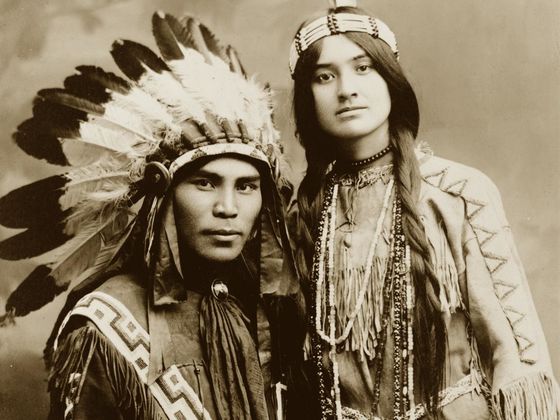
(Source: http://www.harisingh.com/newsNative.htm)

Native Americans have suffered through the loss of their culture, their land, their lives, and even their history, since the settlement of Europeans in North America. Though they were victims of mass genocide, they are often never discussed or acknowledged for being a significant part of the United States’ History. There are still many of them left today, carried through bloodlines and living on reservations. Technically, everyone else is an immigrant, and they are the natives, but they are often treated far differently.

While the plot of the movie revolved around Hugh Glass attempting to avenge his son’s death, who was actually half Native American, I started to focus on the way that Native Americans were depicted and this influenced me to research more about their customs and culture, because Native Americans should be seen as more than people who violently scalp others.

The scene that particularly stands out to me is when the Native American chief, Elk Dog, played by Duane Howard,  is trying to bargain with the French for horses and the French man states that they won’t accept the pelts because they were stolen from the Americans. Elk Dog masterfully replies “You all have stolen everything from us. Everything! The land. The animals.”  I can’t even begin to describe how true this statement is, and even though the movie was very powerful overall, this is the main scene that has engrained itself into my head.

“The Revenant” is a movie about survival, but it is more than the survival of a man in the wilderness. It encompasses the survival of human beings, and our tendency to survive no matter what is thrown at us. No matter our ethnicity or gender, we will endure. We will survive. More than that, we will thrive.

Header: http://acrossthemargin.com/the-revenant/

Stop Hate: How Even with the Knowledge of the Bystander Effect, People still Refuse to Act

“I know somewhat too much; and from this knowledge, once one has been infected, there seems to be no recovering” (Coetzee 21).

A majority of Americans enjoy living their lives with the notion that ignorance is bliss. If they turn away from the issues around the world, then they don’t exist. Unfortunately, poverty, hate, stereotyping, just to name a few, do not disappear when they are ignored. They only grow stronger.

In J.M. Coetzee’s Nobel Prize winning novel, Waiting for the Barbarians, the ideas of barbarism, and who is really a “barbarian,” are developed through the unnamed Narrator’s inner conflicts about his own Empire, especially when he sees the horrible actions that “civilized” people commit. A barbarian is defined as “a person in a savage, primitive state” but it also means “a foreigner or someone living outside of a specific civilization.” Just the definition alone separates people into categories of “us” and “them,” with both sides thinking that they are correct.

Going back to the quotation at the start, this separation between people leads to many being unaware or unwilling to help their fellow humans. Eve when someone has the gut feeling that what they are doing, or witnessing, is wrong, they often do nothing about it. This is called the Bystander Effect.

21d15611377463-560f6b642b13e

The Bystander Effect is categorized by the diffusion off responsibility by one, or many. This means that people are less likely to stand up to a wrongdoing when others are present.

(Source: https://www.behance.net/gallery/11377463/The-Bystander-Effect)

This happens because people, including myself, often tell themselves that someone else will help, or that if no one else is helping, then why should they? Even when they see something bad happen, know that it is wrong and are unable to forget about it, they still do nothing.

It is similar to when us Americans learn about some horrible event elsewhere in the world, and we just nod our heads, thinking “Oh, how terrible,” yet never moving a finger. “This event is too far away,” we reason. “There is nothing that we can do to help. Besides, it doesn’t affect me directly. I know it is happening, but I have not been face to face with the issue.”

That reasoning may be sufficient for not helping people in other countries, but what about all the hate crimes on our own soil? Do we have an excuse for standing by and watching stereotypes physically and mentally manifest into violence?

Ever since Donald Trump has been in the running for the Presidency, and ever more since he has won, there has been a huge increase in hate crimes, especially towards Muslims, Mexicans, and women.  In fact, most minorities feel unsafe. I’m white, but I feel unsafe because I’m a woman and many of my family members fit into these categories.

Now that there is such an increase in danger, wearing a safety pin isn’t enough to stand up to injustice. It is the time to act. Instead of hoping that others will stand up when someone is being victimized, stop being a bystander and do something. It takes just one person to make a change. Be that person. Make that change.

This video contains an explanation of the Bystander Effect, as well as multiple experiments which showcase the effect in action.


Coetzee, J. M.. Waiting For The Barbarians. London : Secker & Warburg, 1980. Print.

Header: http://www.pri.org/stories/2016-09-19/how-likely-are-you-be-victim-hate-crime

Website Powered by WordPress.com.

Up ↑

Create your own website, free on WordPress.com.Create your own website.
Start free